Collect calibration prompts
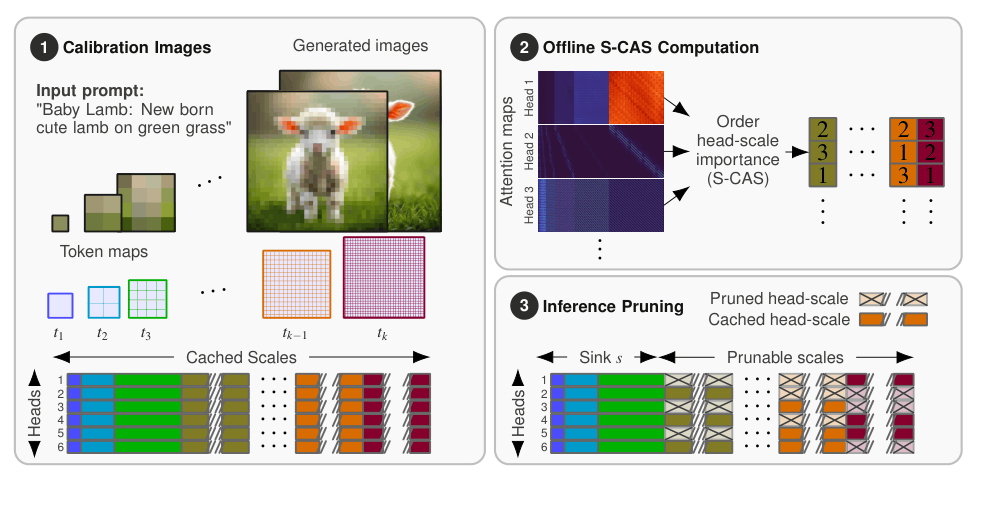
A small offline prompt set is used to observe attention patterns as the VAR model generates token maps at increasing scales.
Computer Vision | AI Research | Arm
Head-tuned KV-cache Compression for Visual Autoregressive Modeling
1 Arm 2 Department of Automatic Control, Lund University
Overview
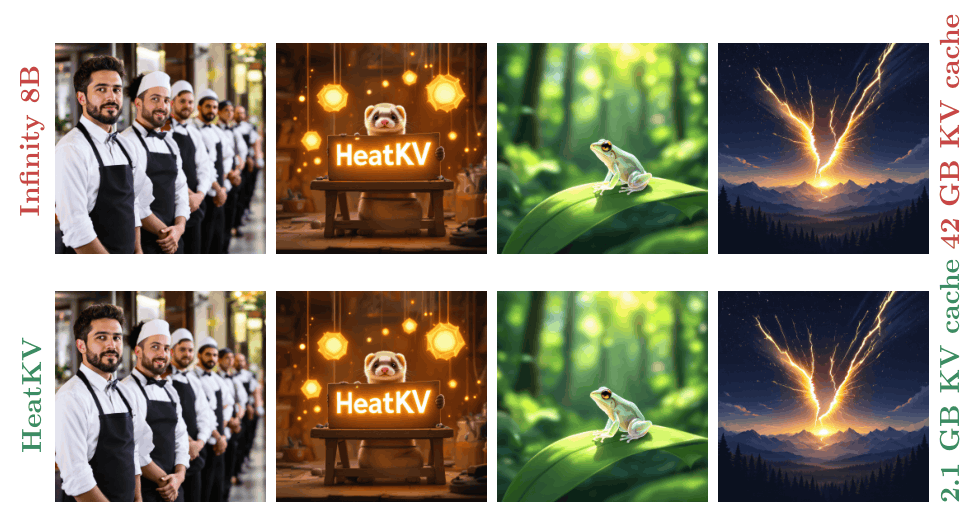
Visual Autoregressive (VAR) models can generate high-quality images with low latency, but their KV caches can consume gigabytes of accelerator memory for every generated image. This limits batch size and makes high-resolution image generation difficult on memory-constrained hardware.
HeatKV introduces a fine-grained compression policy that adapts cache allocation for each attention head and image scale. A small offline calibration set is used to calculate the Scale-dependent Cumulative Attention Score (S-CAS), which ranks how strongly each head depends on previously generated scales.
From these rankings, HeatKV builds a static pruning schedule for a chosen memory budget. It removes low-importance head-scale pairs while retaining the cached information that contributes most to future generation, preserving fidelity, prompt alignment, and perceptual quality under aggressive compression.
How it works
HeatKV turns stable attention patterns into a predictable cache-allocation policy that meets a user-selected memory budget throughout image generation.
A small offline prompt set is used to observe attention patterns as the VAR model generates token maps at increasing scales.
Attention probabilities are aggregated for each layer, head, source scale, and future generation scale.
S-CAS ranks head-scale pairs by their contribution to future predictions, capturing more detail than binary head or layer classes.
The target memory budget determines how many low-ranked head-scale pairs must be removed while early sink scales are retained.
A static schedule and greedy early-pruning policy keep cache use within budget as new scales are generated, without prompt-dependent allocation.
Evaluation
On Infinity-2B, HeatKV at a 10% cache budget outperforms the strongest reported baseline at a 20% budget across FID, LPIPS, and PSNR.
| Method | Budget | KV cache | FID ↓ | LPIPS ↓ | PSNR ↑ |
|---|---|---|---|---|---|
| Full cache | 100% | 38,550 MB | — | — | — |
| ScaleKV | 20% | 7,800 MB | 1.94 | 0.079 | 24.93 |
| HeatKV | 10% | 3,900 MB | 1.67 | 0.073 | 25.40 |
| HeatKV | 4% | 1,590 MB | 2.70 | 0.127 | 22.14 |
See the paper for full results across all baselines, budgets, models, and evaluation metrics.
Citation
If you find this work useful, please cite the HeatKV paper:
@misc{cederlund2026heatkvheadtunedkvcachecompression,
  title={HeatKV: Head-tuned KV-cache Compression for Visual Autoregressive Modeling},
  author={Jonathan Cederlund and Axel Berg and William Isaksson and
          Durmus Alp Emre Acar and Chuteng Zhou and Pontus Giselsson},
  year={2026},
  eprint={2605.14877},
  archivePrefix={arXiv},
  primaryClass={cs.CV},
  url={https://arxiv.org/abs/2605.14877}
}